Merkle Trees in C with OpenSSL
Introduction
There’s plenty of detailed information about Merkle Trees around and it’s not going to be regurgitated, here. A simple online search will turn up any number of articles with varying levels of detail (and, frankly, quality). As usual, Wikipedia is as good a place to start as any. There’s also a particularly good one by Marc Clifton at The Code Project.
Broadly, the problem Merkle Trees try to solve is that of data integrity and consistency. Imagine a large dataset maintained by multiple, untrusting, decentralised parties who each store their own copy. All these copies must remain in sync, but how?
One solution is for each party to constantly receive copies of everyone else’s dataset and run byte-by-byte comparisons against their own. Obviously, though, this is inefficient. Bandwidth costs alone will make this solution prohibitive. They could be mitigated by agreeing to run a synchronisation just once per day or once per month, but what if this isn’t frequent enough? What if the application the parties are serving requires near real-time consistency?
A more practical way is for a hashing algorithm to be run against each dataset and the resulting digest sent to every party for comparison. This will be a much smaller value (for instance, the SHA256 hashing algorithm is just 32-bytes in size). If one party has computed a different hash from their dataset when compared to another party, clearly they are out of sync and work must be done to remediate.
There is still a problem, though. While parties are better off with this solution because datasets with matching hash values need no work at all, for hash values that don’t match, large amounts of bandwidth and processor time are still being used to locate and patch differences in datasets. All a mismatched hash does is tell a party there is a problem somewhere in their data. They’ve still got to run a comparison until the mismatch is found.
The next stage, then, is to split the dataset into blocks and compute a hash value for each block. Now, every party has a list of hashes to compare and it only needs to re-synchronise blocks where the hash comparisons fail. There are still multiple hashes flying around the system, though, and while it’s, no doubt, faster, parties must maintain lists of which hashes represent which blocks.
So, the final step? A Merkle Tree.
A list of blocks and their associated hashes are generated, as described above. The hashes are extracted into a list which forms the bottom layer, or leaves, of the Merkle Tree which is then built upward, layer by layer. The hash list is split into pairs of hashes and the left and right hashes of each pair are concatenated, then hashed again. These new hashes form nodes in the next layer of the tree. This process continues until there is only one hash left, known as the root hash.
For any layer with an odd number of hashes (that is, a layer that cannot be split into left and right pairs evenly), the last hash is duplicated and used as the right hand hash.
The root hash is then sent around the system and compared with every other party’s root hash. If they are found to be different then a comparison is run in which trees are be traversed from top-down to find the point at which the hashes changed. This will lead to the offending data-block which can be patched and the root regenerated. This process continues until the root hashes match.
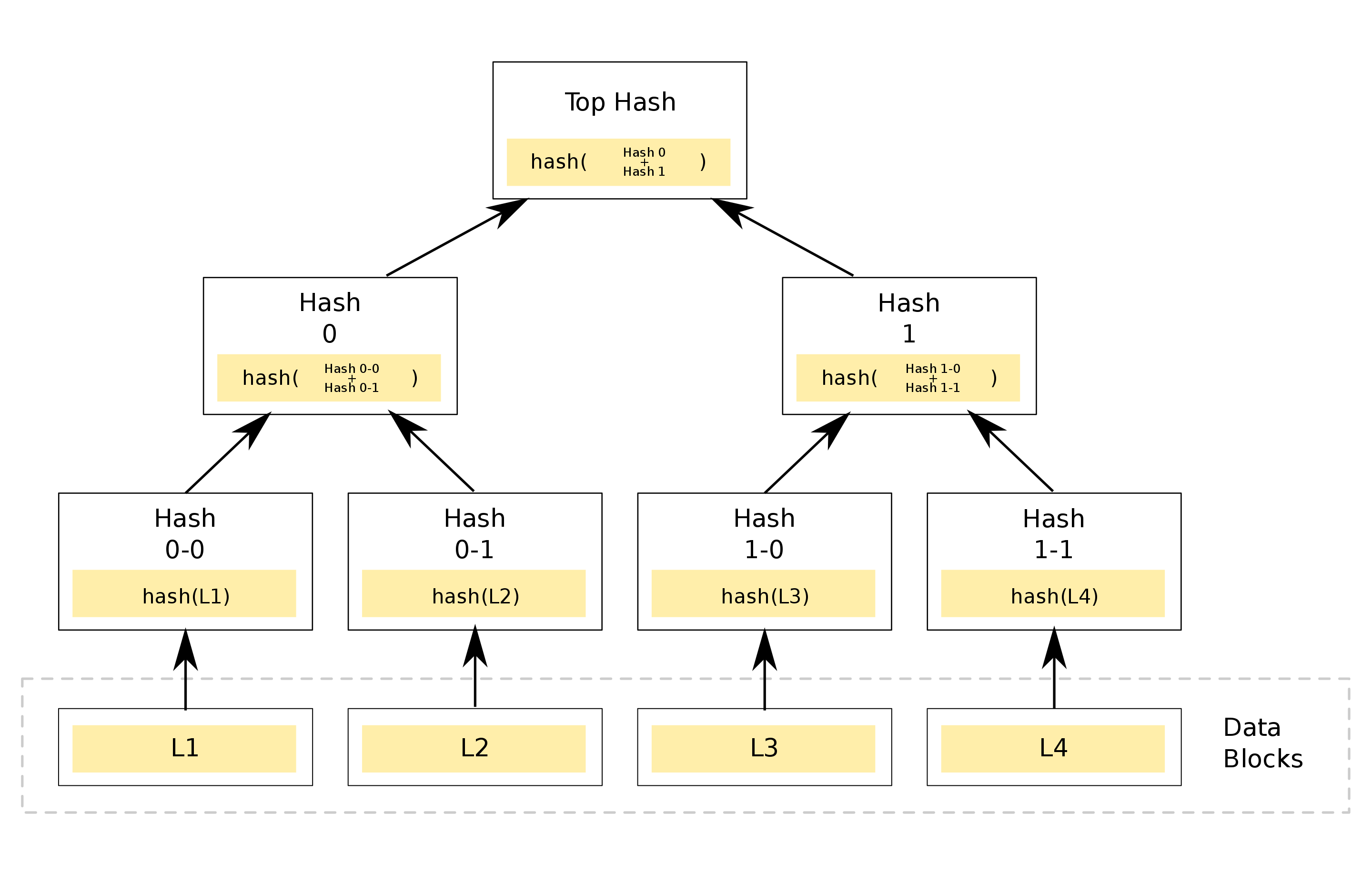 Image by Azaghal - Own work, CC0, https://commons.wikimedia.org/w/index.php?curid=18157888
The Repo?
Source can be found at: https://github.com/chris-j-akers/merkle-trees-in-c
The repo contains a basic implementation of a Merkle Tree written in C.
The tree is built out of a file of newline (‘\n’) separated words. It may seem an unrealistic dataset, but this is just an exercise - building the tree correctly is the focus - and such test data means 1) Logging information about the Merkle Tree being built from English words instead of chunks of binary data blocks means it’s far easier to see what’s going on when reviewing the logs, and 2) it’s simple to procure a sizeable chunk of such test data in a simple format because there are are a few places out there that provide English dictionary text files intended for building spell-checkers.
In the ./test-data directory of this repo there is a 5MB file of 466,550 newline-separated words providing a healthy test dataset of 466,550 blocks or leaves. It was downloaded from: https://github.com/dwyl/english-words.
Repo Contents
| ARTIFACT | DESCRIPTION |
|---|---|
./cakelog/ | Source for the logger used to output debug information https://github.com/chris-j-akers/cakelog. Needs to be compiled with merkle_tree.c |
./test-data/ | Contains a sample test data file of english words, as described above. |
merkle_tree.c | Source |
Building merkle_tree.c
OpenSSL is used to generate the SHA256 hash digests in this program so you will need the OpenSSL libraries installed on your system before it will compile properly. Instructions can be found at https://www.howtoforge.com/tutorial/how-to-install-openssl-from-source-on-linux. You will need to install the headers: sudo apt install libssl-dev on Unbuntu distros.
To generate an executable called mtree, run the following command from the repo directory:
gcc merkle_tree.c ./cakelog/cakelog.c -o mtree -lssl -lcrypto -lm
Program Usage
Once the program has compiled to get the root hash of the example data set (466,549 words) execute:
➜ ./mtree ./test-data/ukenglish.txt
The following output should be displayed:
1
2
3
4
5
6
7
8
9
10
11
12
13
14
15
16
17
18
19
20
21
22
23
24
25
26
27
28
➜ ./mtree ./test-data/ukenglish.txt
reading file ./test-data/ukenglish.txt
read 466550 words into buffer
building leaves...
building tree ...
allocated space for 233275 node pointers in next_layer at address 0x7feb67f47010
allocated space for 116638 node pointers in next_layer at address 0x7feb67e63010
allocated space for 58319 node pointers in next_layer at address 0x7feb67df1010
allocated space for 29160 node pointers in next_layer at address 0x7feb67db8010
allocated space for 14580 node pointers in next_layer at address 0x556c51970d70
allocated space for 7290 node pointers in next_layer at address 0x556c51bc6e30
allocated space for 3645 node pointers in next_layer at address 0x556c51cf1ee0
allocated space for 1823 node pointers in next_layer at address 0x556c51d87780
allocated space for 912 node pointers in next_layer at address 0x556c51dd2470
allocated space for 456 node pointers in next_layer at address 0x556c51df7b90
allocated space for 228 node pointers in next_layer at address 0x556c51e0a770
allocated space for 114 node pointers in next_layer at address 0x556c51e13db0
allocated space for 57 node pointers in next_layer at address 0x556c51e18920
allocated space for 29 node pointers in next_layer at address 0x556c51e1af20
allocated space for 15 node pointers in next_layer at address 0x556c48f826f0
allocated space for 8 node pointers in next_layer at address 0x556c51e1cd30
allocated space for 4 node pointers in next_layer at address 0x556c51e1d310
allocated space for 2 node pointers in next_layer at address 0x556c51e1d650
allocated space for 1 node pointers in next_layer at address 0x556c51e1d840

================================================================================
Root digest is: bc4550eaefb5c8cc2ea917f3533b1e4635ffa232555de1d80f82634514223a35
================================================================================
The root hash of the dataset (466,550 words) is:
1
bc4550eaefb5c8cc2ea917f3533b1e4635ffa232555de1d80f82634514223a35
This hash will never change no matter how many times the program is run against this dataset, and with it being only 64-characters long (or 32-bytes as it’s internal representation) this ‘fingerprint’ is trivial to pass to multiple parties so they can use it in comparison with their own root hash generated from their version of this dataset. What’s more, the SHA256 hash algorithm is a well-known standard. As long as other parties are using this same algorithm they don’t need to use mtree to calculate the root hash of their datasets. They don’t even need to use the same language.
Even the tiniest difference in the data will result in a vastly different root hash. For instance, of the 466,550 words in the above test file one will be removed: ‘war’ from line 453,705 (Lennon would be proud!)
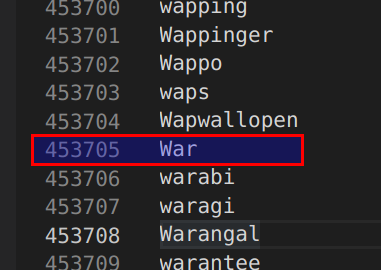
Now, re-running the program the root hash has changed considerably:
1
2
3
4
5
6
7
8
9
10
11
12
13
14
15
16
17
18
19
20
21
22
23
24
25
26
27
28
➜ ./mtree ./test-data/ukenglish.txt
reading file ./test-data/ukenglish.txt
read 466549 words into buffer
building leaves...
building tree ...
allocated space for 233275 node pointers in next_layer at address 0x7f0045df8010
allocated space for 116638 node pointers in next_layer at address 0x7f0045d14010
allocated space for 58319 node pointers in next_layer at address 0x7f0045ca2010
allocated space for 29160 node pointers in next_layer at address 0x7f0045c69010
allocated space for 14580 node pointers in next_layer at address 0x55aa70901cd0
allocated space for 7290 node pointers in next_layer at address 0x55aa70b57d90
allocated space for 3645 node pointers in next_layer at address 0x55aa70c82e40
allocated space for 1823 node pointers in next_layer at address 0x55aa70d186e0
allocated space for 912 node pointers in next_layer at address 0x55aa70d633d0
allocated space for 456 node pointers in next_layer at address 0x55aa70d88af0
allocated space for 228 node pointers in next_layer at address 0x55aa70d9b6d0
allocated space for 114 node pointers in next_layer at address 0x55aa70da4d10
allocated space for 57 node pointers in next_layer at address 0x55aa70da9880
allocated space for 29 node pointers in next_layer at address 0x55aa70dabe80
allocated space for 15 node pointers in next_layer at address 0x55aa67f136f0
allocated space for 8 node pointers in next_layer at address 0x55aa70dadc90
allocated space for 4 node pointers in next_layer at address 0x55aa70dae270
allocated space for 2 node pointers in next_layer at address 0x55aa70dae5b0
allocated space for 1 node pointers in next_layer at address 0x55aa70dae7a0

================================================================================
Root digest is: e7c09c1e40b8267fccfeb8fd3d96b9493812f098b50886e90e04dec446da784d
================================================================================
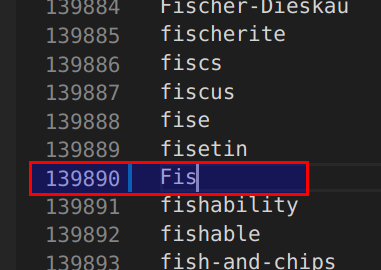
In-fact, even just a single letter changed somewhere in the original file will result in a very different root hash. Below, is the result when the letter ‘h’ has been removed from the word, ‘Fish’.
1
2
3
4
5
6
7
8
9
10
11
12
13
14
15
16
17
18
19
20
21
22
23
24
25
26
27
28
➜ ./mtree ./test-data/ukenglish.txt
reading file ./test-data/ukenglish.txt
read 466550 words into buffer
building leaves...
building tree ...
allocated space for 233275 node pointers in next_layer at address 0x7fabca617010
allocated space for 116638 node pointers in next_layer at address 0x7fabca533010
allocated space for 58319 node pointers in next_layer at address 0x7fabca4c1010
allocated space for 29160 node pointers in next_layer at address 0x7fabca488010
allocated space for 14580 node pointers in next_layer at address 0x55d18c0dcd70
allocated space for 7290 node pointers in next_layer at address 0x55d18c332e30
allocated space for 3645 node pointers in next_layer at address 0x55d18c45dee0
allocated space for 1823 node pointers in next_layer at address 0x55d18c4f3780
allocated space for 912 node pointers in next_layer at address 0x55d18c53e470
allocated space for 456 node pointers in next_layer at address 0x55d18c563b90
allocated space for 228 node pointers in next_layer at address 0x55d18c576770
allocated space for 114 node pointers in next_layer at address 0x55d18c57fdb0
allocated space for 57 node pointers in next_layer at address 0x55d18c584920
allocated space for 29 node pointers in next_layer at address 0x55d18c586f20
allocated space for 15 node pointers in next_layer at address 0x55d1836ee6f0
allocated space for 8 node pointers in next_layer at address 0x55d18c588d30
allocated space for 4 node pointers in next_layer at address 0x55d18c589310
allocated space for 2 node pointers in next_layer at address 0x55d18c589650
allocated space for 1 node pointers in next_layer at address 0x55d18c589840

================================================================================
Root digest is: 504bb987a3501c5581a910a7a99ad300441da8ce301e0e0a93361fa65e20f9dd
================================================================================
…and, finally, when everything is put back together.
1
2
3
4
5
6
7
8
9
10
11
12
13
14
15
16
17
18
19
20
21
22
23
24
25
26
27
28
➜ ./mtree ./test-data/ukenglish.txt
reading file ./test-data/ukenglish.txt
read 466550 words into buffer
building leaves...
building tree ...
allocated space for 233275 node pointers in next_layer at address 0x7fea607ef010
allocated space for 116638 node pointers in next_layer at address 0x7fea6070b010
allocated space for 58319 node pointers in next_layer at address 0x7fea60699010
allocated space for 29160 node pointers in next_layer at address 0x7fea60660010
allocated space for 14580 node pointers in next_layer at address 0x558de50c2d70
allocated space for 7290 node pointers in next_layer at address 0x558de5318e30
allocated space for 3645 node pointers in next_layer at address 0x558de5443ee0
allocated space for 1823 node pointers in next_layer at address 0x558de54d9780
allocated space for 912 node pointers in next_layer at address 0x558de5524470
allocated space for 456 node pointers in next_layer at address 0x558de5549b90
allocated space for 228 node pointers in next_layer at address 0x558de555c770
allocated space for 114 node pointers in next_layer at address 0x558de5565db0
allocated space for 57 node pointers in next_layer at address 0x558de556a920
allocated space for 29 node pointers in next_layer at address 0x558de556cf20
allocated space for 15 node pointers in next_layer at address 0x558ddc6d46f0
allocated space for 8 node pointers in next_layer at address 0x558de556ed30
allocated space for 4 node pointers in next_layer at address 0x558de556f310
allocated space for 2 node pointers in next_layer at address 0x558de556f650
allocated space for 1 node pointers in next_layer at address 0x558de556f840

================================================================================
Root digest is: bc4550eaefb5c8cc2ea917f3533b1e4635ffa232555de1d80f82634514223a35
================================================================================